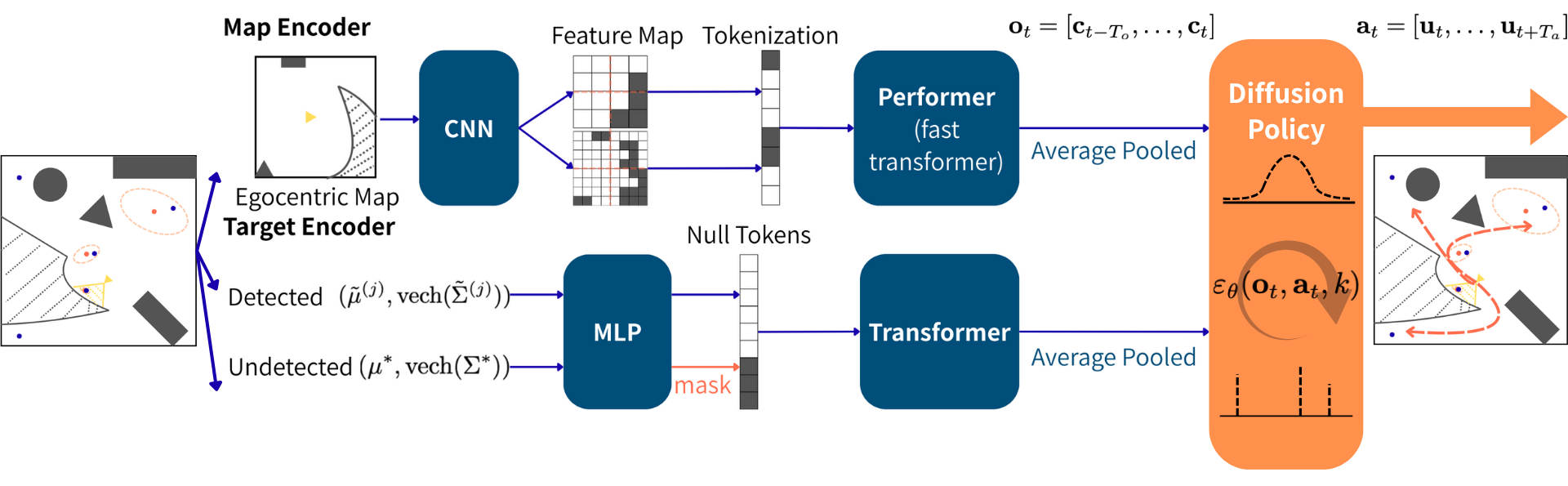
MATT-Diff conditions a denoising diffusion model on two learned encodings of the agent's
current observation.
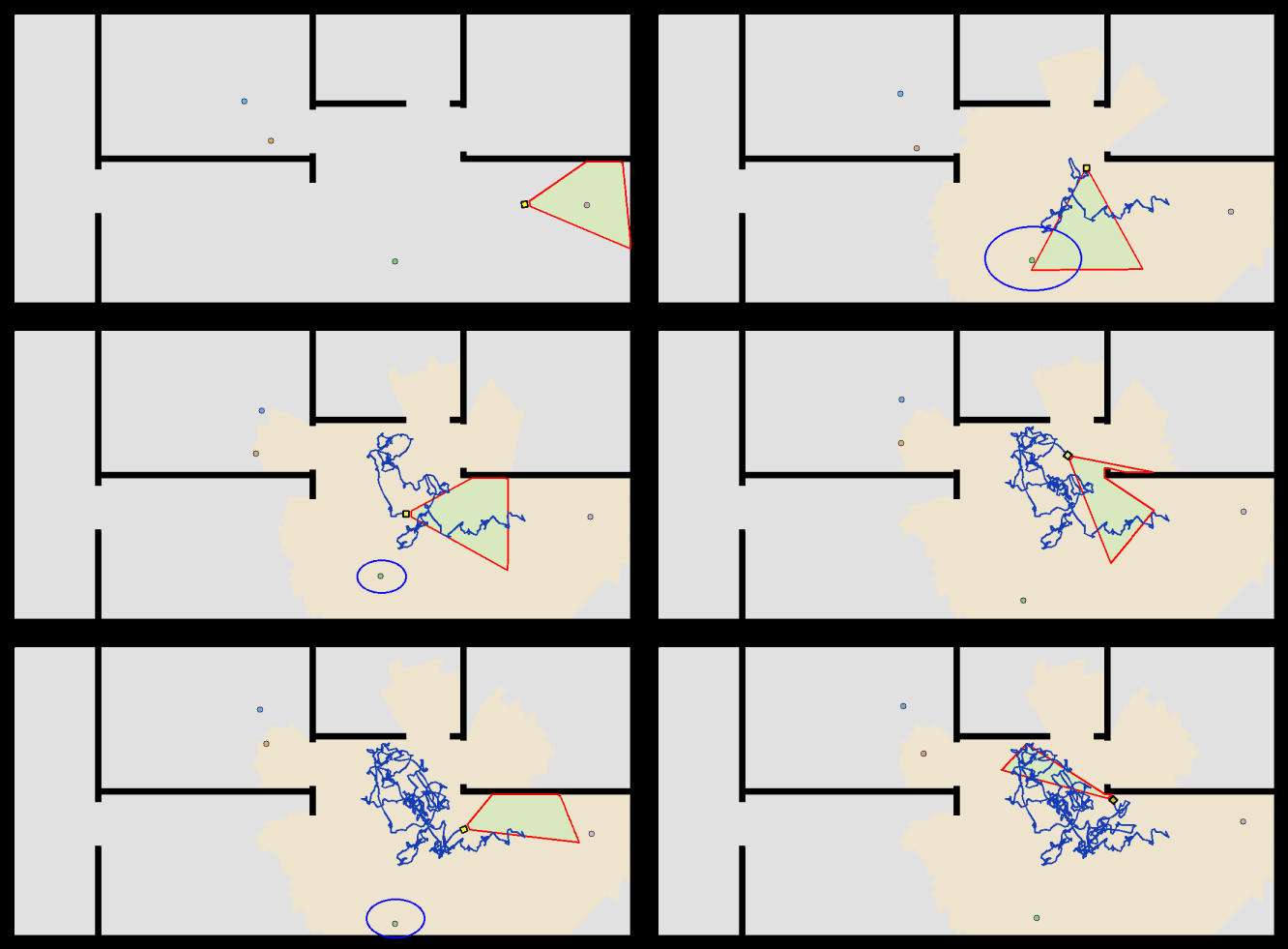
Map Encoder — processes a 4-channel ego-centric local map:
(1) known free space (binary), (2) unknown space (binary),
(3) visit frequency (continuous, normalized), and
(4) current field of view (binary).
A CNN stem downsamples the input, then dual-scale patch tokens are fed into a
Performer Transformer (linear attention with Random Fourier Features + RoPE),
and the CLS token is used as the map embedding.
Target Encoder — processes the Gaussian belief state (position mean
and covariance) of each target slot. Undetected or lost targets are replaced by a
learned null token. A Transformer encoder with self-attention processes all slots,
and detected slots are aggregated via masked mean pooling into a fixed-size embedding.
When no targets are detected, a global null fallback embedding is used.
Both embeddings are concatenated and passed to the diffusion policy network, which
iteratively denoises a sampled action over multiple diffusion steps at inference time.